segunda-feira, 23 de outubro de 2017

Them Bones of Adventure - III: Searching

Continuing my exposition on table procedures for common exploration feats & rules, which began here with part one.

Introduction

The procedures of the search seem like they would be one of these really minor, blink-and-you’d-miss-‘em blip on the rules radar, a minor trifle if anything.

Yet this topic is one of the main pillars of old school play and how it is treated at one’s table speaks volumes of the tone set for a game. There is good reason for this as it is one of the foremost instances (by association with traps, the passing of time and the possibility of random encounters) where player creativity and input can become rather frequently solicited: deciding when to search, what to search for, where to search for it, and how to do it are all finer points of player expression which should have real implications on the end result, in numerical bonuses (if new school) or direct results (when old school). By comparison, a player’s not usually invited to wax poetic about a sword thrust from his character, but when searching for nooks all of the words have to be measured, the abstraction taking a back seat and interaction with the description becoming very important indeed.

Traditional play dealt with this in a very loose fashion, intuition being the watchword of the day, things were either In Plain Sight – described readily upon coming under a character’s notice, Concealed – meaning they were found as soon as a character declared he searched the general proximity of the correct spot or Secret – requiring a die roll to find even when a search effort was directed at the correct place.

Since I’m bridging an adaptation here, I’ll retain these terms and attempt to translate this approach to current mechanics.


That’ll be just the check, please – the Collective Roll Syndrome

A noticeable folly of the new school, I’ve seen players signal the referee to coast a search along, ask for dice to be rolled and just be presented with the itemized final tally of what they’ve found in a whole room.

This time around, in addition to abstrusely dispersing the relevant information in three separate entries (maybe more as these were the ones I could find) Fifth Edition seems to not have made up its own mind on how to treat this: the sidebars titled “Hiding” and “Finding a Hidden Object” pointing in semi-conflicting directions. Eventually, as going by the current books, we’re soon led into an ugly place in terms of game design: the collective search roll.

I’ve had a gut-problem with collective party rolls for searching since my first reading of the rules. Here is a place that inequivocaly points to the superiority of old school play, wherein the players cannot simply wander into a room and each pay their due d20 perception rolls like at a toll booth and expect to be rewarded with shinies if they score high. It’s just too easy, too mindless. 5th does take the positive step of requiring input from the player for the search to be a valid one, but doesn’t go quite as far as I’d like.

What’s worse: metagaming rears its ugly head but quickly, once a given player rolls poorly, in barges the nearest party mate, knuckles a-cracking to repeat the search “just to make sure the ranger searched things right”; rinse, repeat, nauseate. Lets face it: if something was hidden to the point of resisting a search by the highest of 4-to-6 Perception rolls we can pretty assuredly assert that it just wasn’t made to be found, conversely, knowing most things won’t stand to that kind of character scrutiny, why bother?

Granted, plenty of old school blogs nowadays have pretty much homed in on good procedural for doing this, so I’ll just push this along to completeness and avoid earning further stripes in obviousness. The Alexandrian, as well as Hack & Slash tackled this effectively, the first one even coopting some useful new school concepts (“take 10/20”) that already were implicitly present in old school play but simply lacked such designation, gelling it all together.

The Crunchy Bits

Searching is a choice of action that implies free hands or adequate tools and a minimum degree of illumination, meaning candles can actually be of use in providing localized light while at the same time minimizing the party’s profile to attention from the exterior. Characters focused on a search may well become disadvantaged at noticing other things so it is advisable to post a lookout.

Searching for static objects, whether hidden doors, items, features or traps is to be done dicelessly save for those cases so cornered that they’re basically rabid beasts. It’s a very stable albeit time-consuming task, hence my leaning that only the players’ options and the character’s Passive Perception, modified by circumstances and mode of search, are to count. This is basically the interpretation of the traditional methodology as shifted through the lens of the 5E mechanical frame. 

Remember: Perception only tests the character’s senses, whereas Searching is a lot more about deduction and investigative inspiration (i.e. actual play through meaningful choice) than rolling a die to see if you blinked at the wrong time. Also, note that despite referring to Perception throughout, I don’t care to formalize which skill bonus is actually applicable (Perception, Investigation or other), it’ll be subjected to adjudication on a per-case basis.

Verbal Declaration – Player Input

This is intended as the obligatory ground floor to whatever search effort the player wishes the character to engage in. The search pattern is directed by the player in relation to the description handed by the referee and the method of searching (Rummage, Rote or Thorough) is selected.

Whenever a player feels like the situation merits it, he can describe his search in greater detail, the character being thus allowed to manipulate his surroundings in a way that still adheres to the numerical logic of the rules, since without the proper input he’ll only ever find items or features hidden within his perception range, but can occasionally supersede them if adequate action is taken, for example smashing a sealed cubic urn upon the ground to access its contents instead of attempting to find a delicate opening mechanism concealed on its underside or spilling water to watch if it seeps through any hidden cracks instead of being helplessly prevented from finding an otherwise impossibly-well-hidden trapdoor.

Single Glimpse – Skill Check

A character that only gets one glimpse through a corner as he tries to count the number of denizens in a room or he wants to assess details as he steals a quick glance down a side-passage while on the run from something nasty; Basically, when pressure and uncertainty collide, randomization is the answer.

Ransack – Skill Check

When time is of the essence and the character wishes to wantonly rummage through a room’s contents, ransacking takes half the time of a rote search and can even yield better results depending on the roll, but I’ll impress upon the players that it is exceedingly noisy and absolutely careless behaviour, and the gains of rolling high (i.e. matching a Thorough Search at most) are probably not worth the accumulated risk of Fumbling and attracting undue attention or even breaking fragile treasure.

I’m willing to retain the maligned option of rolling for Searches as I can appreciate its borderline uses (and recognize that sometimes change is hard to impose at a table) but I'll be sure to stress that as soon as the d20 is lifted, it’s all on fate and the player's shoulders: I only let characters fail forward when there’s a swordpoint or a pit trap greeting them at the other end.

Standard or Rote Search – or “Take 10” – Passive Average Perception Score

This total is actively applied to whatever the character searches at a slow pace, taking a rough average of 10 minutes per 10’x10' area searched, 10' of wall section, or 2 minutes per handheld object inspected. Multiple searchers linearly accelerate the process.

Thorough or Detailed Search – or “Take 20” – Maximum Perception Total

Nets the best possible search effort that the character can muster, as per having rolled 20 on the die, slowing the pace to a crawl and taking five times as long as a rote search to perform.

Orientation on DCs

Note that I’m really only mechanically concerned with Hidden level of information. Concealed things are given to anyone who merely takes the time and indicates searching in the correct place (meaning they’ll have a DC in the 7-10 range if that), the rest being In Plain Sight and either directly part of the referee’s initial description or obtained immediately upon request (for example, the texture of the walls, the height of the ceiling, any plant growth or discolourations, etc).

Going with the static totals requires some thinking about DCs, as the searching efforts become very stable: keep in mind that something labelled “Hard – DC 15” will be found by anyone – even a Perception 3 character – with a thorough search; while it takes a DC of 27+ to ensure that a character maxed out in Perception (taking 20, +4 mod, +2 from Proficiency) cannot find a chest buried under flagstones.

I’ll most likely (d)evolve my approach into gut-feeling these numbers as a “requires rote search to find/requires thorough search to find” simplified heuristic labelling, the actual DC being little more than a numeric middleman that will prove the most useful when writing or adapting published material. Time will tell.

Modifiers

Not many that I can produce, but searching under dim-light (since movement is already pretty hard-coded into the search modes), will impose a -5 to the Perception total. Again, I should only resort to the numbers when discretion fails me.

Closing Thoughts - Relativizing the importance of missed content

A word relating to the importance of missed content. This type of occurrence will only ever truly matter in a revisitable megadungeon or a place where otherwise several parties with varying rosters of players are likely to pass through. It only really carries any weight that we lock some information or item in a fixed place if the importance of doing it is demonstrably not spurious, otherwise it is ourselves that we’ll be fooling. With but one party to master, whatever they don’t find in the first comb-through is very much akin to never having existed in the first place, as even later maps pointing to a supposedly original hidden place can be created out of thin air after the fact, along with the placement for the reward.

My adoption of the above system was rooted on this asymmetry between unknown difficulty (since a player can never know for sure if there is something hidden when he searches or not) contrasted with the player’s own public rolls, conspiring to create this inelegant metagaming vortex of die after die being thrown at a problem until the desired high roll comes along and the referee has to tell a crestfallen player that no, there really isn’t anything there worth the chase, all this punctuated with the occasional pavlovian score that shines through only to perpetuate the behaviour.


quarta-feira, 18 de outubro de 2017

Them Bones of Adventure - II: Light

Continuing my exposition on table procedures for common exploration feats & rules, which began here with part one.


Introduction

Light is the lifeline of dungeon delving. Even more than rope or sustenance, light sources in pits of indissoluble darkness are a complete game changer for those willing to embrace the challenges of exploration and wishing to avoid succumbing to the plagues of convenient glowing fungi or networks of eternally fuelled sconces patrolled by the world’s most sysiphean workforce, 1/0 switch definitely included.

Modelling light itself is much like the abstraction of an abstraction, one that at the best of times can hardly hope to be traced with perfect boundaries and rigour. My advice, this coming from someone who has wasted his share of time trying to adjudicate the clash of atoms, is to take the burden of its meaningfulness to where you can and avoid falling prey to blatant irrealism but otherwise avoid sweating too much on it; it is a windmill waiting to be tilted and one that emphatically should not dominate the proceedings. Err on the generous side with this one.

Shared Woes – Anatomy of a Houserule

Turning light into a non-handwaveable notion requires that it should not be a challenge affecting just a select slice of any given party of explorers.


I’m all for the possibility of magical items and spells as means of overturning a problem, but decidedly less keen on the demihuman condition at large, whose suite of abilities invariably tends to include that which mitigates a key part of human psychology, which all ought to share: the fear of the dark.

Unless they’re of proven cave dweller stock (and thus actually sensitive to daylight!), I’m houseruling in favour of demihumans having low-light vision (mechanically, simply treating dim light as bright light) instead of darkvision, with the pertinent exception of Dwarves and maybe some Gnomes, but still at a range not exceeding a claustrophobic 30 feet.

The Crunchy Bits

Light Sources (and Light Radius)

There are no bullseye lanterns and the lanterns that do exist, instead of the usually implied default of renaissance fare, are modelled on the medieval lanthorn type, that hems the light from a candle or oil lamp in a cage protected with strips of thinly stretched animal skin or translucent panes of bone (hence the name) and thus still vulnerable to being blown out though retaining an edge on duration compared to a torch.

So, going with:

- Candles: 5’ of light radius, lasting 30 minutes

- Oil Lamps: 15’ of light radius, lasting 1 hour

- Leviathan' Oil Lanthorns: 20’ of light radius, lasting 3 hours

- Torches: 20’ of light radius, lasting 30 minutes, d4 fire damage if used as melee weapon, but must check to see if the light extinguishes

N.B: Both these radii and durations are a purely gamey abstraction that does nothing but mock the subtle intricacies of the real world; I am nothing but proud of them.

I’m keeping the dual radii of Bright plus Dim Light, as per the book, meaning the above figures for each light source are accompanied by an effective doubled range consisting of dim light.
The dim light radius, however, is predicated on the light source being held high. Should the bearer drop or deliberately throw his light aside such as to free up his hand for combat, this kills the dim light, leaving only the bright light radius in effect.

Who’s Holding the Light?

Within the metrically drawn confines of the dungeon corridor, a ready answer leaps forth; yet other, vaguer times may well challenge the collective notion of where exactly is the light emanating from. Like I wrote before, if the party’s not illogically drawing a blatant full radius from a rearguard-borne torch, err on the side of generosity.

That said, the “who” part remains important, due to the fact of having to give up a hand slot. This’ll mostly mean no use of two-handed weapons without dropping the light source.

Additional Light Sources

Opening the possibility of more than mere redundancy in clustered lighting:


- Multiple significant (i.e. stronger than a candle) light sources in overlapping proximity increase the ambient dim light radius by 5’ for each additional light beyond the first.

I pondered several things but went with the flat & gross simplification. As of yet I'm playing it cautious with this one, just adding the bare minimum to the weaker typed light radius, but there ought to be something here to further develop past being conservative and without compromising "realism" (adding more radius per light or  enough sources eventually adding to the bright radius).

When does the Light run out?

Three general ways:

- When delving: Encounter Roll enriched with the relevant entries (one for solid fuel sources like torches/candles, the other for oil-based lanthorns/lamps);

- Flat time counting if travelling or doing something more stable and time-consuming than outright exploration.

- A (pseudo)breakage roll (automatic, d2, d4 and d6 for each successive light source type) to extinguish the flame whenever there’s an occurence to justify it, such as the light being forcibly dropped, a gust of wind or some spell effect; Particularly strong winds may snuff lights out with no recourse to a roll.

Closing Thoughts - Some notes on behaviour

Though things will not constantly reach this level of deviousness, due to variables such as creature organization, courage, intelligence and inherent behaviour, always consider the possibilities of:

- Attacks with missiles from beyond a (not necessarily the) party's sight;

- Staging hit and run attacks that exploit a party’s limited light radius;

- Hazing explorers with noises outside their sight distance, leading the characters to make mistakes or panic;

- Attacks that deliberately target the light bearer;

- Creatures (such as wildlife or certain cave dwellers) who will shirk the light or exposed flames and ostensibly avoid confrontation on these grounds.


Proceed to part three: Searching


quarta-feira, 11 de outubro de 2017

Them Bones of Adventure - I: Climbing

Introduction

I’m of the opinion that good rules make for better rulings.

Starting with this post is a short series dedicated to the tentative procedures I intend to use to adjudicate some of the most common feats in an explorer’s violent and risky existence. With these I aim to establish a working basis from which one can branch out into competent, cohesive and engaging rulings at the table.

The corresponding chapters on the fifth edition PHB and DMG take the carefree and heartwarming approach of letting all of these concerns be suspended on the individual referee’s goodwill. As you may have surmised already, I’m not a very big proponent of goodwill, if only because I think it hurts one's game.

My two main vectors of approach are concerned with hitting a sweet spot on abstraction vs. gameability and a relative minimization of referee interference. I understand we never quite get rid of arbitrariness and that as long as we stick to logic that is not a problem. But if you’re going to have characters cracking their bones and ending their miserable lives in play, you’ll find good value in having the degree of insulation afforded by the players knowing damn well what they sign up for when choosing a risky course of action.

As before, the result of all this will then spill onto a couple of sheets dedicated to general table rules, but since they’re not yet done I’ll be colatting them from posts such as this one.

Let us then begin with Climbing.

As explorer feats go, this one’s not terribly common; many DMs usually opt to make all their dungeons level with the ground or sunk in the convenient way of underground parking garages. Let’s be perfectly clear on this: dungeons feel a lot more like dungeons if the characters have to negotiate serious obstacles to access them and if, once inside, they can feel the press of all that rock above them, reminding that there’s one (or more) hundred-foot climbs separating them from actual freedom. It then ceases being just a question of running for your life if shit goes sour, rather it becomes a matter of needing the full extent of your athleticism and teamwork to even be able to exit the dungeon, let alone doing it while chased or laden with plunder.

Personally, I wouldn’t think to run a dungeon feature – rock spire, canyon wall, deep crevice, reversed gravity room – much less a whole vertical dungeon, without a significant and robust rule basis.


Speaking of holy grails, this can also play a part in making the wilderness a more gameable place, as natural features can become tangible situations to be tackled rather than always folded into simple narration or a slowed rate of progress on the map.


The Crunchy Bits

Main Tool of the Trade – Rope

When purchasing, note how much weight it can hold by its breakage die; for simplicity, its cargo potential can be based on how many people it can hold (typically, half the breakage die total so three grown men for a d6) and extrapolate anything else you might need from there. Note that this is information that the players know, so that important decisions can be taken, instead of activating handwavium or blind guessing. It’s the characters’ lives literally on the line and they’re no amateurs.
In any event, rope breakage should only be tested directly in selected instances, such as when the cargo capacity is clearly exceeded.


Unchallenging Climbs

In usual circumstances, with no threat to life or limb, only the lead climber ever rolls; once he secures a workable rope rig topside any subsequent climbers can be deposited leisurely in the arms of abstraction, elapsing time but dispensing with further rolls.


Conversely, horizontal movement along safety rigging, slow descents with aid from rope and climbing small distances – up to 10’ – can all be handled well by the simple-simon 5E rules of ascent and descent being made at half-speed.


Free Climbing


Assign an openly known DC based on how hard to climb the surface is, keeping it at a low threshold (DC 4-8).

The climber tests his Strength (Athletics) to make headway:

- On failure, the character is stymied by lack of footing, a patch of loose rock or shortness of breath; he makes no progress this round.

- On success, he ascends a number of feet corresponding to the modified roll’s result. On a natural 20, add another d20 feet of progress.

- On a fumble (unmodified 1 in d20), something drastic has befallen the character: stricken by exhaustion, equipment failure, sudden loss of climbing surface integrity or prosaic slippage and he must make a Strength or Dexterity saving throw (applying Acrobatics or Athletics), DC equal to 5 plus the climb’s difficulty. If the save is made, apply d4 damage from overexertion; On failing, the character plunges to his doom.

Not covered as yet: more protracted climbing distances will doubtlessly necessitate some form of additional check for exhaustion.

Falling


Death by physics, such as resulting from a fall, is something utterly dispassionate and uncaring, horrible to behold; by all accounts a profoundly stupid way to die no matter the context.


That said, I’m strongly in favour of immodest falling damage. I hate it that RPGs seem to go out of their way to trivialize falls, to the point where the math turns high-level characters into bouncy videogame avatars.

For the time being I simply doubled the PHB’s falling damage into a flat d6 for every five feet. Meaning a 10’ fall does 2d6 damage, still nowhere near to what reality will dish out but perhaps sufficient for the purpose. Also to be considered, the d6 assumes a soft ground baseline. I advocate shifting to 1 damage for water, d4 for sand, d8 for hard stone surfaces and d10/12 for bespeared pit traps

For retainers and assorted chaff, feel free to either snap their neck on arrival or declare the character Wounded and reduced to 0 hp and skip right to rolling on the dismemberment table.

Protected Climbing

If the character makes use of hammer and pitons, plus a person to stand as a belayer on the ground or at a stable midpoint of the climb, the lead climber can make a much safer ascent by means of sticking the pitons into the rock face and relaying the rope through them.


- Make a note or a rough drawing of the climb; should the climber fall, the fall distance will count as being twice the distance to the nearest placed piton. Arrested falls that avoid the ground will deal d4 damage per every five feet.


Example: the climber drives a piton at a given point during a climb, next turn he progresses 13 feet and then he falls. His fall, given the rope is immediately tensed by the belaying companion, will be arrested 13 feet below the anchoring piton, hence resulting in a total falling distance of 26 feet for 5d4 damage, due to whiplash and slamming against the rock face.

A healthy string of pitons at 3-foot intervals will always keep the damage from a fall at a very survivable d4 but then, for a limited stock of pitons, this leads into a necessity of choice, which is just what I want from it.

Abseiling

Rappelling for a swift descent ought to be resolved by a single Dexterity (Acrobatics) check: you’re always going down, it’s just a matter of at what speed. Failure will probably imply some minor (d6) damage from impacts, rope burn or excessive speed on descent, but nothing drastic will happen unless the character fumbles.

Grappling Hook

Using a grappling hook is a good way to beat a short climb, though a character can’t hope to throw a heavy metal hook with accompanying rope chaser at too high a vertical distance.

Simple it goes: [Strength (Athletics), DC = nr. of feet to the desired anchoring point]


- Once you hit, assume that the hook sticks and it ought to be fairly linear from there: use the simple half-movement rules.


- Failures are exactly that and don’t prevent retries in any way, fumbles indicate that the hook got lost or, though I'm wary of recommending this, older editions do it with some hard scene framing, skipping right into mid-ascent, as the anchor dislodges at a random point of the climb (percentile dice being your friend here).


Closing Thoughts - Avoiding the whole thing

As a closing statement, it is my hope that once I've added this layer of gravitas to a lengthy climb, superseding it with a flight spell or avoiding certain death from it with featherfall will become that much more valued as the players come to appreciate the heft of what they’ve avoided.


Proceed to part two: Light 

sexta-feira, 6 de outubro de 2017

Beastly Burdens and Deathly Strikes

As a stop-gap to my next series of posts, I thought to tighten a few rivets on my encumbrance and dismemberment modules.

Beastly Burdens

I continue my drive to make Encumbrance relevant by way of unforgivingness.

Without abdicating from abstraction, let us say that I don’t quite like the way encumbrance currently affects physical actions outside of combat.

In combat, sure, adrenaline kicks in and being burdened for the whole of two minutes is not such a drastic thing as it might seem and appears well covered by the existing rules, no, I’m looking at the more sustained kind of efforts, feats like swimming, climbing, hiking and sneaking by.

I _dearly_ wanted One Blanket Rule to bind them all and in the darkness spank them instead of a case-by-case finangling but I just don’t think that does the different situations justice. After all, encumbrance adversely affects both swimming and sneaking in harsh yet completely different ways, one being about reducing water resistance and weight, the other being about silhouette reduction and minimization of noise.

Thus my aim’s to make the following changes, in ascending order of severity:

Hiking/Marching: If a character’s encumbrance total exceeds the difficulty rating of sustaining a forced march, it is used instead.

Climbing: Every encumbrance point past Unencumbered (1/4 the character’s strength total) increases the climbing difficulty class by one.

Swimming: Any encumbrance point increases the swimming difficulty class by one.

Sneaking: Every encumbrance point past Unencumbered and every occupied slot past fast-access increases the fumble margin by one.

Deathly Strikes


Deathly Strikes are those attacks or hazards whose rolled damage exceeds the character’s maximum hit-point total. Things such as falling a great distance or getting squarely (critically) clubbed on the head, the kind of events where getting away with *just* a broken limb is considered fortunate.

These kinds of injuries, since their damage exceeds and defies absorption by the ablative hp total, are rolled on the Death and Dismemberment table with a single d6, excluding the whole upper, more forgiving, side of the table.

sexta-feira, 29 de setembro de 2017

Close Encounters of the 3d6th Kind


I’m here to wave a flag. The flag of randomization.

Sustainable randomization at the table is a glorious standard to fly in the fight against narrativism and the rule of arbitrariness. Randomization needs to be deft and flexible, and necessitates a sharp GMing mind to process the results into something that makes sense and can be slotted seamlessly into the game world.

There’s a quintessential example that has sadly fallen into disuse: the classic “3d6*10 feet encounter distance".

5th edition criminally makes absolutely no mention of it, choosing instead to pore over mind-numbing “challenge rates” accounting, oblivious to the fact that a fatefully placed encounter can punch a lot harder than what its CR might announce… or be calculated for.

This is one of the prime examples of fiat by default, and one that seriously weighs on character survivability at a table where most of the rolls are made in the open and the holds are definitely not barred: at what distance is the opposition spotted or spawned into existence? At a convenient distance for some? At an inconvenient distance for others? Who’s to decide?

While reading LotFP’s Encounters chapter I followed that dotted line of reasoning into realizing the gaping maw of implications created just by skipping over this simple dice roll…

Seriously, chuck those three suckers a couple of times and tell me you’re not faced with this string of intriguing possibilities, albeit all of them being, of course, simple variations of the duality “rolling high or low” since the only variable here is distance but wherein, with just this humble deference to fate, the encounter may unexpectedly:

- Clearly be placed out of range of the party’s sight, either in an entirely different room or, also interestingly, outside the party’s light-source radius.

- Be spotted right in the party’s direct vicinity, meaning it’s either an ambush or something else quite atypical (an Ogre spotted thirty feet from the party in the middle of a featureless room is clearly dead or asleep, not attempting an ambush, unless he’s just playing dead).

- Be spotted at such distance as puts the opposition on the other side (or inside) of a chasm or some other challenging terrain feature. The situation then being free to evolve into a firefight or whatever else.

- Be placed at a standardly accessible point but already within charging distance, prohibiting the use of ranged weapon options. You may skip to Initiative and pray.

- Appear at such a distance as to allow the party to make a clean getaway if they so wish it or to prepare more elaborate measures.

Note that I don’t wish for things to get too algorithmic and videogamey here, if the returned result does not serve, discard it and exercise discretion. But not rolling these and skipping straight to the arbitrariness feels like missing out. You can have an encounter with the same old patrolling Orcs play out in completely novel and unexpected ways.

All you need is some contextualizing topography, meaning encounters in the dungeon are easiest to make work, whereas the more abstract wilderness will necessitate some fleshing out or additional randomization procedures to gain significance, but otherwise note how, after the single toss, the encounter already breathes some life of its own as you’ve yet barely lifted a finger.

I’m considering the addition of some things besides, as an attempt at enriching the information returned by this single roll for pretty much the same overhead:

- Making one of the d6s a Jeff Rients’ activity die (high result meaning “activity/awareness”, low result meaning “idleness/unawareness”).  If the party’s been noisy, one can count the highest roll, if the party’s been cautious, the lowest roll can be it.

- Assigning another one of the d6’s for the encounter’s bearing relative to the party (1-4 for the cardinal directions, 5 for “below or ambush”, 6 for “above or lurking”. Another option worth exploring might be to employ some kind of secondary visual interpretation of the die roll: drawing an imaginary line from highest rolling die to the lowest or vice versa, to act as a scatter die.

- Making the final d6 a rough marker, in 5’ increments, of how scattered the elements of the other group are.

And, of course, I release this post into the wild without even having broached the expansive vistas of tampering with the distance multiplier or the dice tipology itself, for 3d6 * 10’ is but the gateway to this particular drug.

Here too I find myself pondering if urban and wilderness encounters might not be better abstracted with much bigger distance multipliers, also inviting the opposite idea of shrinking the distances for a more claustrophobic underworld experience as being a definite possibility, one that might even turn into a distinct motif for certain dungeons or monster behaviour: “these things always appear breathing down your neck in the ancient tunnels!”.

domingo, 24 de setembro de 2017

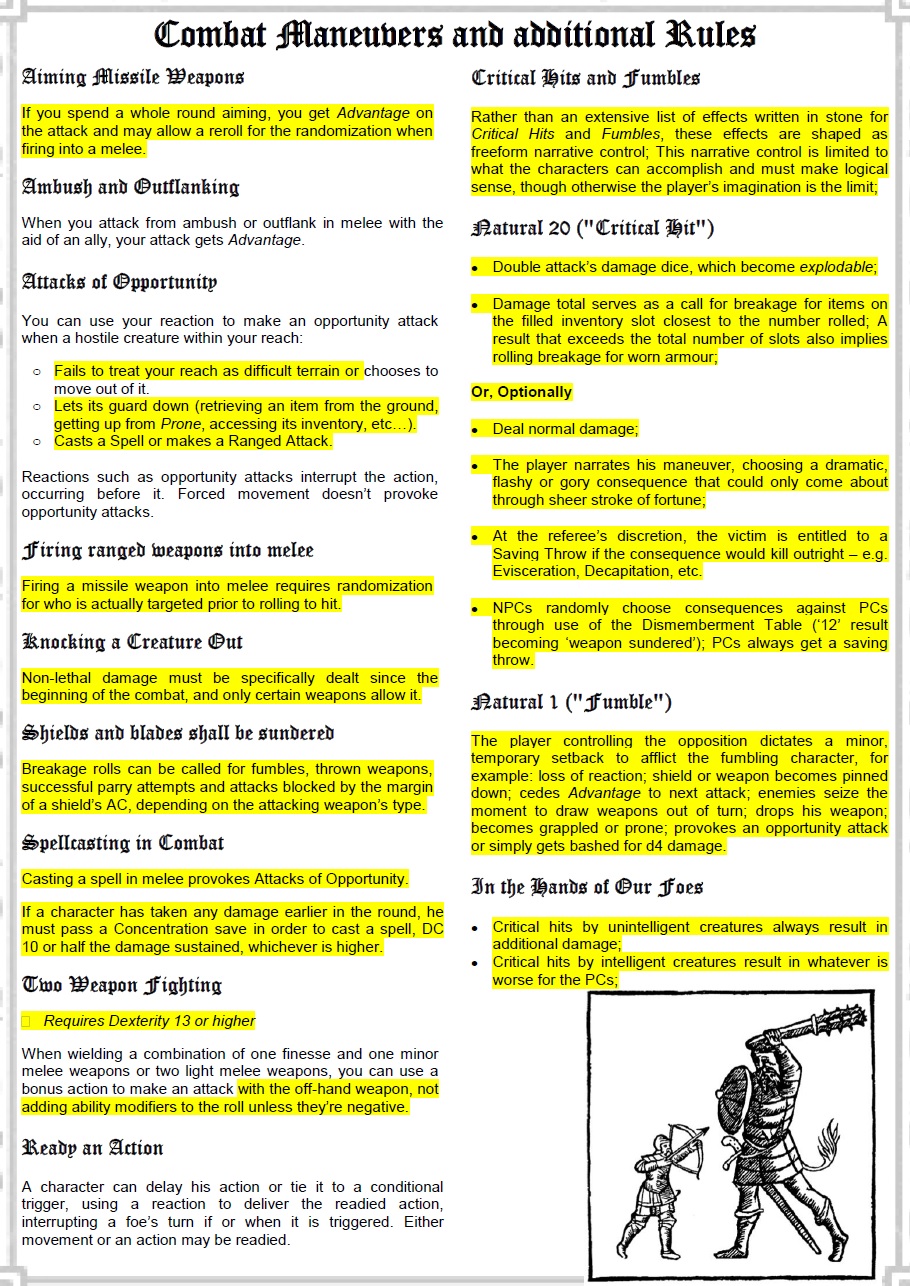
The illustrated Art of being Unpleasant

Combat Maneuvers & Rule Miscelanea

Mostly minor adaptations from the core book this time around, for the most part I did little more than dismember some feats or mine the monster manual and incorporate what I found back into the general maneuver list. Fifth edition feats seem to have been made in loose accordance with Cortney Campbell’s definition of the useful feat – already some signs pointing to OSR influence upon the mainstream – it is a design philosophy that I too believe in,  which maintains, among other things, that feats should not be things that allow characters to do basic maneuvers (like charging or parrying), but rather that improve upon the general capabilities already at any character’s disposal.

I ransacked Lamentations of the Flame Princess’s weird pages for inspiration, integrated a few maneuvers from the DMG, tweaked some targetting restrictions, nothing fancy. It should be noted that the PHB does the right thing by keeping maneuvers simple, general and few in number, with a couple of cases from which a referee can extrapolate whatever is needed.

I skipped wholly over prize gems such as “attack”, “ranged attack”, “use object”, “hide” and “search”, as they’re either obvious or I don’t consider them to be combat maneuvers at all.

For the places that I deemed needed more than just some touching-up:

Opportunity Attacks
Basically, it is to be assumed that if you’re focusing on anything other than holding a melee weapon in close quarters, the other guy will try to run you through.
This includes Ranged Attacks and Spellcasting within the enemy’s reach, since both of these are instances in which the caster/shooter is in combat while positively not focusing on wielding a melee weapon. If this won’t prompt an opportunity attack, I don’t know what will.

Threat reach
Characters moving freely within an enemy’s reach is something that rankled right from the first take when seen at the table. I changed this so that characters within enemy reach must tread as though in difficult terrain or trigger an attack. It’s a compromise between 4E’s “single side-step” and 5E’s near-total lack of restrictions. 

Dash
Tightened up the wording and restricted its use to characters who have already spent their entire movement breaking into a run while also requiring that the extra move be made in the same direction as the movement before.

Charge
This was for me the maneuver that launched a thounsand hacks. 
I understand that its relegation to feat status was probably due to it demanding that the character obey a few situational requirements, meaning it wasn’t “new user friendly”. At any rate I reintroduce it, though the requirements are stringent (since dashing becomes harder to trigger), meaning its use is to be but occasional, probably limited to a skirmish’s first contact.

Disengage
Minor but significant change. It just felt too artificial for me to have creatures neatly walk away from near-engulfment by large groups of enemies. I appreciate that this maneuver is better off as staying dicelesss but it’s too irrestricted and means that mobs have little chance of, well, mobbing an opponent.

Parry
Adapted from the (rather irrealistic) feat. This is one I’m not very sure about, but wanted characters to have defensive options while not rejiggering the balance, so the bonus is small and intended mostly for PC use.


Feint
Pretty much all of the book’s mundane at-will sources of Advantage, with “Help” standing out in particular, grate on me profoundly. Since I plan to fiddle with the general rules for teamwork, there was no way I was letting this stay as is. Added some versatility to compensate for the fact that it now requires a roll, meaning no more “Advantage on demand”.

Grapple (and Pinning)
Cleaned up the wording and opened an option for clinching that was locked behind a feat. Also inserted the LotFP clause for restricting attacks to sidearms while in a tussle. Dagger groundfighting here we go.

Shields & Blades shall be sundered
A different take on an old classic. Basically a way to keep equipment attrition happening instead of fading into obscure irrelevance. Although there is no specific “Sunder” maneuver, as I consider that such a thing occurs in combat not so much deliberately as more a result of ill fortune, there are plenty of ways (Fumbles, parrying heavy weaponry, thrown weapons missing their target) to call for breakage checks.

Dual Wielding
Here I took the opposite direction of the PHB and reintroduced the classic DEX minimum to employ this fighting style. I don’t care about democratization in this one instance. Reconfigured the penalty too, taking away the bonus to hitting instead of to damage, improving the stance’s logic and to reward the fact that you have your damage output dependent on two discrete rolls. Switching the restriction around means it’s still flawed but seems better to my eyes than the PHB version.

Spellcasting in Combat
Thanks to LotFP, a clean and neat dampener to casting while in combat: if you took damage earlier in the round, you must succeed in a Concentration save or forfeit casting for that round.

Maneuver Improvisation and Stunts
Cemented a few more guidelines for improvisation at the table. It could be argued that this is strictly Referee-ruling procedure, but I kind of want players to keep the possibilities in mind and make use of them, which is why I’ve placed this on the maneuver list, so that it’ll burrow into their subconscious.

Lastly, a couple of not-so-minor changes, with which I open the door to experimenting with player narrative control:

Critical Hits
Influenced by Zak Smith, I propose two options for critical hits:

1) The doubling of damage (a total also made to interact with equipment breakage), upgraded in lethality with explodable dice, put into place so that low damage weapon users don’t default to the narrative control.


2) Rolling normal damage, the player is then granted narrative control to make what he will of the hit, being free to maim, gouge, cripple or just add a stylish touch.

Here’s where the lid comes off. Other than straight up killing your opponent (which nets him a save), the sky’s the limit. I’m very curious to see what players come up with, given the opportunity.

I also worried for the characters’ integrity at the claws of critting monsters, since statistics are not exactly on the players’ side, thus deciding to place some restrictions on the DM side of things, while still retaining a feeling of tension.


Fumbles
Brought in line with the critical hits, this becomes a provider for a watered down level of narrative control. For the DM, this changes little, since he already was doing the fumbles for everyone including the PCs, so its the players’ input that remains to be seen.


yellow marker

terça-feira, 5 de setembro de 2017

Dumping Practices

The problem of the dump stat

I call this a problem like it is a bad thing. It’s not.

The incontrovertible fact is that the game invariably tests the physical attributes in a much more prominent fashion, leaving plenty of leeway for the other three statistics to go from being treated as middling number dumping grounds to being gulag of the single digit. I don’t see this as a failing but as a feature. Trying to over-systemize the use of Charisma, Intelligence or Wisdom at the table to a degree that’s anywhere near to the consistent focus granted to the physical stats would result in clunky awkwardness.

The game’s nature by itself ensures that the mental attributes are to act more as holdbacks than enablers, to be superseded by player input at each and every given opportunity, of which a good game ought to have plenty. For the application of the players’ Wisdom, Charisma and Intelligence is where the game at its most pure really is played, the hampering stats only serving for cutting the corners of impractical instances – This is only right to my mind and not a trend I wish to see in any way diminished.

What do I want, then? Simply: for the player to pine for high stats across the board. To raise the bar for the perfect character and for less monochrome characters to be viable.

Charisma is for Bards, Constitution is for everyone

Since time immemorial, the trend went thus: if you had the good fortune to get three or more good stats, it served to be a martial archetype, where all three physical stats would tend to be engaged often and plentifully. If you got two middling-to-good stats, you aimed for a mixed caster, like a Cleric or Druid, that you’d be able to swing your higher numbers in melee and disguise your mediocrity with some casting. And, if you got one or no high numbers to speak of, you went with a pure caster, the spellcasting itself only necessitating a middling attribute and magic either covering or, in certain cases, completely obviating the other shortcomings. I want to make the stat attribution facet of the game a conclusion less foregone.

I appreciate that, in a skill system like 5th Edition’s, the mental attributes associate their modifier with a much greater number of skills, but these are either of marginal use to the average dungeon delver, not directly associated with life-or-death situations or – and this right here was the tipping point – their benefits usually extend to the collective party, not the individual character.

We all know DnD is a cooperative team game, but lets ponder incentives: once the party has the smooth talker to CHA-forceps the local becrowned quest dispenser or the high WIS native is there to spot all the maiming-but-never-quite-death-dealing contraptions littering the dungeon, where does that leave the characters with the _second_ highest totals in Charisma, Intelligence or Wisdom? If a player picks a fighter, having him be as mentally thick as a cinder block is usually not an issue, due to the nature of the collective benefits afforded by the mental attributes, you just double down on clinging to “the path of what I was going to do anyway”, letting the WIS-primary class shoulder the burden of trap detection, the CHA-primary do the hireling recruitment and the INT-primary decipher riddles. Since the niche is neatly filled and you never were going to compare with the specialists anyway, you’re left with very little to show for your invesment, why do it at all? 

Please note that even the relative traction of the above scenarios all hinges on the rather generous assumption that your table uses the mental stats in the above mentioned-but-not-prescribed way. They may be worth even less in a more old-school running. This is where granting more individualized incentives comes in.

I want to break these molds of “any investment in a mental attribute beside it being the party's highest brings only marginal reward” and “having two characters in a party with the same high mental attribute results in diminished returns”, which certainly does not affect any of the physical attributes, since they all give some individualized benefit or penalty even if they’re not what a given character’s class is primarily about and they all contribute directly to the character’s survival.

As design constraints go, this’ll mean affording a little extra value to the mental stats without upsetting the class balance. It’ll need to be simple. It’ll also be important for the changes to have no impact on monster capabilities (who, in 5th edition, have actual stat blocks).

Wisdom & Intelligence

Where does one’s Wisdom end and one’s Intelligence begin? I’ll leave that for the academics; for the matter at hand I’ll say that both are required to learn, either from processing events as-lived or for extrapolating from the experiences of third parties through direct observation or otherwise.
I intend for both of these stats to contribute to a single percentage, not unlike the “prime” stats of urDnD, with each modifier point corresponding to a percentage point of greater or, if negative, lessened experience gain.

Here I snagged on the impracticality of having a player constantly adding 3% or subtracting 2% from all their gains. Very inelegant and user-unfriendly. The solution? Apply the final percentual tally once to the Xp total required to attain the next level, then accumulate Xp as normal.

Charisma

I haven’t at this point made up my mind on the use of Reaction Rolls, but if I do end up using them, they’ll be made on the traditional 2d6 and affected by half this stat’s modifier, rounded down, to account for 5E’s largesse with modifiers.

Beyond this, I’m a bit loathe to load down the talky part of the game with rolls where it should all be as squicky and direct as possible.

I’ve also gotten aboard with the somewhat romantic notion of Charisma as luck or divine favour. Now, crunchwise, this might be difficult to translate.

Tentatively, I’m going to use it as a randomization device or tie-breaker, by which if a trap, hazard or unintelligent creature requires a roll from the referee to specify targetting for a special attack or to determine which of roughly equidistant victims it strikes, the referee can ask for the afflicted parties to roll their contested Charisma; this is not to usurp the dictates of logic (such as ambushers or a trap targetting the pointsman) rather applying only to instances requiring a tie-break, in lieu of the more traditional randomization.