quarta-feira, 11 de outubro de 2017

Them Bones of Adventure - I: Climbing

Introduction

I’m of the opinion that good rules make for better rulings.

Starting with this post is a short series dedicated to the tentative procedures I intend to use to adjudicate some of the most common feats in an explorer’s violent and risky existence. With these I aim to establish a working basis from which one can branch out into competent, cohesive and engaging rulings at the table.

The corresponding chapters on the fifth edition PHB and DMG take the carefree and heartwarming approach of letting all of these concerns be suspended on the individual referee’s goodwill. As you may have surmised already, I’m not a very big proponent of goodwill, if only because I think it hurts one's game.

My two main vectors of approach are concerned with hitting a sweet spot on abstraction vs. gameability and a relative minimization of referee interference. I understand we never quite get rid of arbitrariness and that as long as we stick to logic that is not a problem. But if you’re going to have characters cracking their bones and ending their miserable lives in play, you’ll find good value in having the degree of insulation afforded by the players knowing damn well what they sign up for when choosing a risky course of action.

As before, the result of all this will then spill onto a couple of sheets dedicated to general table rules, but since they’re not yet done I’ll be colatting them from posts such as this one.

Let us then begin with Climbing.

As explorer feats go, this one’s not terribly common; many DMs usually opt to make all their dungeons level with the ground or sunk in the convenient way of underground parking garages. Let’s be perfectly clear on this: dungeons feel a lot more like dungeons if the characters have to negotiate serious obstacles to access them and if, once inside, they can feel the press of all that rock above them, reminding that there’s one (or more) hundred-foot climbs separating them from actual freedom. It then ceases being just a question of running for your life if shit goes sour, rather it becomes a matter of needing the full extent of your athleticism and teamwork to even be able to exit the dungeon, let alone doing it while chased or laden with plunder.

Personally, I wouldn’t think to run a dungeon feature – rock spire, canyon wall, deep crevice, reversed gravity room – much less a whole vertical dungeon, without a significant and robust rule basis.


Speaking of holy grails, this can also play a part in making the wilderness a more gameable place, as natural features can become tangible situations to be tackled rather than always folded into simple narration or a slowed rate of progress on the map.


The Crunchy Bits

Main Tool of the Trade – Rope

When purchasing, note how much weight it can hold by its breakage die; for simplicity, its cargo potential can be based on how many people it can hold (typically, half the breakage die total so three grown men for a d6) and extrapolate anything else you might need from there. Note that this is information that the players know, so that important decisions can be taken, instead of activating handwavium or blind guessing. It’s the characters’ lives literally on the line and they’re no amateurs.
In any event, rope breakage should only be tested directly in selected instances, such as when the cargo capacity is clearly exceeded.


Unchallenging Climbs

In usual circumstances, with no threat to life or limb, only the lead climber ever rolls; once he secures a workable rope rig topside any subsequent climbers can be deposited leisurely in the arms of abstraction, elapsing time but dispensing with further rolls.


Conversely, horizontal movement along safety rigging, slow descents with aid from rope and climbing small distances – up to 10’ – can all be handled well by the simple-simon 5E rules of ascent and descent being made at half-speed.


Free Climbing


Assign an openly known DC based on how hard to climb the surface is, keeping it at a low threshold (DC 4-8).

The climber tests his Strength (Athletics) to make headway:

- On failure, the character is stymied by lack of footing, a patch of loose rock or shortness of breath; he makes no progress this round.

- On success, he ascends a number of feet corresponding to the modified roll’s result. On a natural 20, add another d20 feet of progress.

- On a fumble (unmodified 1 in d20), something drastic has befallen the character: stricken by exhaustion, equipment failure, sudden loss of climbing surface integrity or prosaic slippage and he must make a Strength or Dexterity saving throw (applying Acrobatics or Athletics), DC equal to 5 plus the climb’s difficulty. If the save is made, apply d4 damage from overexertion; On failing, the character plunges to his doom.

Not covered as yet: more protracted climbing distances will doubtlessly necessitate some form of additional check for exhaustion.

Falling


Death by physics, such as resulting from a fall, is something utterly dispassionate and uncaring, horrible to behold; by all accounts a profoundly stupid way to die no matter the context.


That said, I’m strongly in favour of immodest falling damage. I hate it that RPGs seem to go out of their way to trivialize falls, to the point where the math turns high-level characters into bouncy videogame avatars.

For the time being I simply doubled the PHB’s falling damage into a flat d6 for every five feet. Meaning a 10’ fall does 2d6 damage, still nowhere near to what reality will dish out but perhaps sufficient for the purpose. Also to be considered, the d6 assumes a soft ground baseline. I advocate shifting to 1 damage for water, d4 for sand, d8 for hard stone surfaces and d10/12 for bespeared pit traps

For retainers and assorted chaff, feel free to either snap their neck on arrival or declare the character Wounded and reduced to 0 hp and skip right to rolling on the dismemberment table.

Protected Climbing

If the character makes use of hammer and pitons, plus a person to stand as a belayer on the ground or at a stable midpoint of the climb, the lead climber can make a much safer ascent by means of sticking the pitons into the rock face and relaying the rope through them.


- Make a note or a rough drawing of the climb; should the climber fall, the fall distance will count as being twice the distance to the nearest placed piton. Arrested falls that avoid the ground will deal d4 damage per every five feet.


Example: the climber drives a piton at a given point during a climb, next turn he progresses 13 feet and then he falls. His fall, given the rope is immediately tensed by the belaying companion, will be arrested 13 feet below the anchoring piton, hence resulting in a total falling distance of 26 feet for 5d4 damage, due to whiplash and slamming against the rock face.

A healthy string of pitons at 3-foot intervals will always keep the damage from a fall at a very survivable d4 but then, for a limited stock of pitons, this leads into a necessity of choice, which is just what I want from it.

Abseiling

Rappelling for a swift descent ought to be resolved by a single Dexterity (Acrobatics) check: you’re always going down, it’s just a matter of at what speed. Failure will probably imply some minor (d6) damage from impacts, rope burn or excessive speed on descent, but nothing drastic will happen unless the character fumbles.

Grappling Hook

Using a grappling hook is a good way to beat a short climb, though a character can’t hope to throw a heavy metal hook with accompanying rope chaser at too high a vertical distance.

Simple it goes: [Strength (Athletics), DC = nr. of feet to the desired anchoring point]


- Once you hit, assume that the hook sticks and it ought to be fairly linear from there: use the simple half-movement rules.


- Failures are exactly that and don’t prevent retries in any way, fumbles indicate that the hook got lost or, though I'm wary of recommending this, older editions do it with some hard scene framing, skipping right into mid-ascent, as the anchor dislodges at a random point of the climb (percentile dice being your friend here).


Closing Thoughts - Avoiding the whole thing

As a closing statement, it is my hope that once I've added this layer of gravitas to a lengthy climb, superseding it with a flight spell or avoiding certain death from it with featherfall will become that much more valued as the players come to appreciate the heft of what they’ve avoided.


Proceed to part two: Light 

sexta-feira, 6 de outubro de 2017

Beastly Burdens and Deathly Strikes

As a stop-gap to my next series of posts, I thought to tighten a few rivets on my encumbrance and dismemberment modules.

Beastly Burdens

I continue my drive to make Encumbrance relevant by way of unforgivingness.

Without abdicating from abstraction, let us say that I don’t quite like the way encumbrance currently affects physical actions outside of combat.

In combat, sure, adrenaline kicks in and being burdened for the whole of two minutes is not such a drastic thing as it might seem and appears well covered by the existing rules, no, I’m looking at the more sustained kind of efforts, feats like swimming, climbing, hiking and sneaking by.

I _dearly_ wanted One Blanket Rule to bind them all and in the darkness spank them instead of a case-by-case finangling but I just don’t think that does the different situations justice. After all, encumbrance adversely affects both swimming and sneaking in harsh yet completely different ways, one being about reducing water resistance and weight, the other being about silhouette reduction and minimization of noise.

Thus my aim’s to make the following changes, in ascending order of severity:

Hiking/Marching: If a character’s encumbrance total exceeds the difficulty rating of sustaining a forced march, it is used instead.

Climbing: Every encumbrance point past Unencumbered (1/4 the character’s strength total) increases the climbing difficulty class by one.

Swimming: Any encumbrance point increases the swimming difficulty class by one.

Sneaking: Every encumbrance point past Unencumbered and every occupied slot past fast-access increases the fumble margin by one.

Deathly Strikes


Deathly Strikes are those attacks or hazards whose rolled damage exceeds the character’s maximum hit-point total. Things such as falling a great distance or getting squarely (critically) clubbed on the head, the kind of events where getting away with *just* a broken limb is considered fortunate.

These kinds of injuries, since their damage exceeds and defies absorption by the ablative hp total, are rolled on the Death and Dismemberment table with a single d6, excluding the whole upper, more forgiving, side of the table.

sexta-feira, 29 de setembro de 2017

Close Encounters of the 3d6th Kind


I’m here to wave a flag. The flag of randomization.

Sustainable randomization at the table is a glorious standard to fly in the fight against narrativism and the rule of arbitrariness. Randomization needs to be deft and flexible, and necessitates a sharp GMing mind to process the results into something that makes sense and can be slotted seamlessly into the game world.

There’s a quintessential example that has sadly fallen into disuse: the classic “3d6*10 feet encounter distance".

5th edition criminally makes absolutely no mention of it, choosing instead to pore over mind-numbing “challenge rates” accounting, oblivious to the fact that a fatefully placed encounter can punch a lot harder than what its CR might announce… or be calculated for.

This is one of the prime examples of fiat by default, and one that seriously weighs on character survivability at a table where most of the rolls are made in the open and the holds are definitely not barred: at what distance is the opposition spotted or spawned into existence? At a convenient distance for some? At an inconvenient distance for others? Who’s to decide?

While reading LotFP’s Encounters chapter I followed that dotted line of reasoning into realizing the gaping maw of implications created just by skipping over this simple dice roll…

Seriously, chuck those three suckers a couple of times and tell me you’re not faced with this string of intriguing possibilities, albeit all of them being, of course, simple variations of the duality “rolling high or low” since the only variable here is distance but wherein, with just this humble deference to fate, the encounter may unexpectedly:

- Clearly be placed out of range of the party’s sight, either in an entirely different room or, also interestingly, outside the party’s light-source radius.

- Be spotted right in the party’s direct vicinity, meaning it’s either an ambush or something else quite atypical (an Ogre spotted thirty feet from the party in the middle of a featureless room is clearly dead or asleep, not attempting an ambush, unless he’s just playing dead).

- Be spotted at such distance as puts the opposition on the other side (or inside) of a chasm or some other challenging terrain feature. The situation then being free to evolve into a firefight or whatever else.

- Be placed at a standardly accessible point but already within charging distance, prohibiting the use of ranged weapon options. You may skip to Initiative and pray.

- Appear at such a distance as to allow the party to make a clean getaway if they so wish it or to prepare more elaborate measures.

Note that I don’t wish for things to get too algorithmic and videogamey here, if the returned result does not serve, discard it and exercise discretion. But not rolling these and skipping straight to the arbitrariness feels like missing out. You can have an encounter with the same old patrolling Orcs play out in completely novel and unexpected ways.

All you need is some contextualizing topography, meaning encounters in the dungeon are easiest to make work, whereas the more abstract wilderness will necessitate some fleshing out or additional randomization procedures to gain significance, but otherwise note how, after the single toss, the encounter already breathes some life of its own as you’ve yet barely lifted a finger.

I’m considering the addition of some things besides, as an attempt at enriching the information returned by this single roll for pretty much the same overhead:

- Making one of the d6s a Jeff Rients’ activity die (high result meaning “activity/awareness”, low result meaning “idleness/unawareness”).  If the party’s been noisy, one can count the highest roll, if the party’s been cautious, the lowest roll can be it.

- Assigning another one of the d6’s for the encounter’s bearing relative to the party (1-4 for the cardinal directions, 5 for “below or ambush”, 6 for “above or lurking”. Another option worth exploring might be to employ some kind of secondary visual interpretation of the die roll: drawing an imaginary line from highest rolling die to the lowest or vice versa, to act as a scatter die.

- Making the final d6 a rough marker, in 5’ increments, of how scattered the elements of the other group are.

And, of course, I release this post into the wild without even having broached the expansive vistas of tampering with the distance multiplier or the dice tipology itself, for 3d6 * 10’ is but the gateway to this particular drug.

Here too I find myself pondering if urban and wilderness encounters might not be better abstracted with much bigger distance multipliers, also inviting the opposite idea of shrinking the distances for a more claustrophobic underworld experience as being a definite possibility, one that might even turn into a distinct motif for certain dungeons or monster behaviour: “these things always appear breathing down your neck in the ancient tunnels!”.

domingo, 24 de setembro de 2017

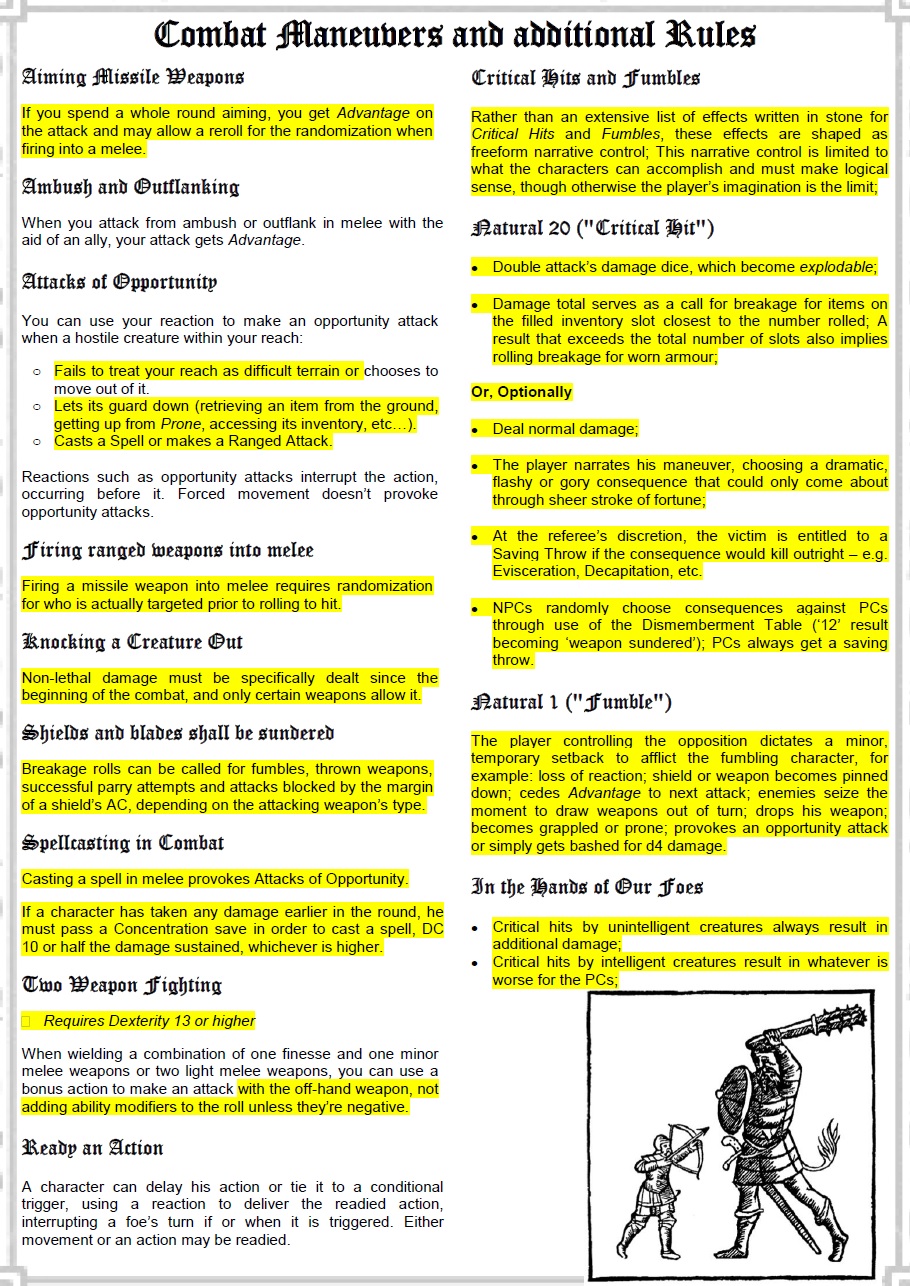
The illustrated Art of being Unpleasant

Combat Maneuvers & Rule Miscelanea

Mostly minor adaptations from the core book this time around, for the most part I did little more than dismember some feats or mine the monster manual and incorporate what I found back into the general maneuver list. Fifth edition feats seem to have been made in loose accordance with Cortney Campbell’s definition of the useful feat – already some signs pointing to OSR influence upon the mainstream – it is a design philosophy that I too believe in,  which maintains, among other things, that feats should not be things that allow characters to do basic maneuvers (like charging or parrying), but rather that improve upon the general capabilities already at any character’s disposal.

I ransacked Lamentations of the Flame Princess’s weird pages for inspiration, integrated a few maneuvers from the DMG, tweaked some targetting restrictions, nothing fancy. It should be noted that the PHB does the right thing by keeping maneuvers simple, general and few in number, with a couple of cases from which a referee can extrapolate whatever is needed.

I skipped wholly over prize gems such as “attack”, “ranged attack”, “use object”, “hide” and “search”, as they’re either obvious or I don’t consider them to be combat maneuvers at all.

For the places that I deemed needed more than just some touching-up:

Opportunity Attacks
Basically, it is to be assumed that if you’re focusing on anything other than holding a melee weapon in close quarters, the other guy will try to run you through.
This includes Ranged Attacks and Spellcasting within the enemy’s reach, since both of these are instances in which the caster/shooter is in combat while positively not focusing on wielding a melee weapon. If this won’t prompt an opportunity attack, I don’t know what will.

Threat reach
Characters moving freely within an enemy’s reach is something that rankled right from the first take when seen at the table. I changed this so that characters within enemy reach must tread as though in difficult terrain or trigger an attack. It’s a compromise between 4E’s “single side-step” and 5E’s near-total lack of restrictions. 

Dash
Tightened up the wording and restricted its use to characters who have already spent their entire movement breaking into a run while also requiring that the extra move be made in the same direction as the movement before.

Charge
This was for me the maneuver that launched a thounsand hacks. 
I understand that its relegation to feat status was probably due to it demanding that the character obey a few situational requirements, meaning it wasn’t “new user friendly”. At any rate I reintroduce it, though the requirements are stringent (since dashing becomes harder to trigger), meaning its use is to be but occasional, probably limited to a skirmish’s first contact.

Disengage
Minor but significant change. It just felt too artificial for me to have creatures neatly walk away from near-engulfment by large groups of enemies. I appreciate that this maneuver is better off as staying dicelesss but it’s too irrestricted and means that mobs have little chance of, well, mobbing an opponent.

Parry
Adapted from the (rather irrealistic) feat. This is one I’m not very sure about, but wanted characters to have defensive options while not rejiggering the balance, so the bonus is small and intended mostly for PC use.


Feint
Pretty much all of the book’s mundane at-will sources of Advantage, with “Help” standing out in particular, grate on me profoundly. Since I plan to fiddle with the general rules for teamwork, there was no way I was letting this stay as is. Added some versatility to compensate for the fact that it now requires a roll, meaning no more “Advantage on demand”.

Grapple (and Pinning)
Cleaned up the wording and opened an option for clinching that was locked behind a feat. Also inserted the LotFP clause for restricting attacks to sidearms while in a tussle. Dagger groundfighting here we go.

Shields & Blades shall be sundered
A different take on an old classic. Basically a way to keep equipment attrition happening instead of fading into obscure irrelevance. Although there is no specific “Sunder” maneuver, as I consider that such a thing occurs in combat not so much deliberately as more a result of ill fortune, there are plenty of ways (Fumbles, parrying heavy weaponry, thrown weapons missing their target) to call for breakage checks.

Dual Wielding
Here I took the opposite direction of the PHB and reintroduced the classic DEX minimum to employ this fighting style. I don’t care about democratization in this one instance. Reconfigured the penalty too, taking away the bonus to hitting instead of to damage, improving the stance’s logic and to reward the fact that you have your damage output dependent on two discrete rolls. Switching the restriction around means it’s still flawed but seems better to my eyes than the PHB version.

Spellcasting in Combat
Thanks to LotFP, a clean and neat dampener to casting while in combat: if you took damage earlier in the round, you must succeed in a Concentration save or forfeit casting for that round.

Maneuver Improvisation and Stunts
Cemented a few more guidelines for improvisation at the table. It could be argued that this is strictly Referee-ruling procedure, but I kind of want players to keep the possibilities in mind and make use of them, which is why I’ve placed this on the maneuver list, so that it’ll burrow into their subconscious.

Lastly, a couple of not-so-minor changes, with which I open the door to experimenting with player narrative control:

Critical Hits
Influenced by Zak Smith, I propose two options for critical hits:

1) The doubling of damage (a total also made to interact with equipment breakage), upgraded in lethality with explodable dice, put into place so that low damage weapon users don’t default to the narrative control.


2) Rolling normal damage, the player is then granted narrative control to make what he will of the hit, being free to maim, gouge, cripple or just add a stylish touch.

Here’s where the lid comes off. Other than straight up killing your opponent (which nets him a save), the sky’s the limit. I’m very curious to see what players come up with, given the opportunity.

I also worried for the characters’ integrity at the claws of critting monsters, since statistics are not exactly on the players’ side, thus deciding to place some restrictions on the DM side of things, while still retaining a feeling of tension.


Fumbles
Brought in line with the critical hits, this becomes a provider for a watered down level of narrative control. For the DM, this changes little, since he already was doing the fumbles for everyone including the PCs, so its the players’ input that remains to be seen.


yellow marker

terça-feira, 5 de setembro de 2017

Dumping Practices

The problem of the dump stat

I call this a problem like it is a bad thing. It’s not.

The incontrovertible fact is that the game invariably tests the physical attributes in a much more prominent fashion, leaving plenty of leeway for the other three statistics to go from being treated as middling number dumping grounds to being gulag of the single digit. I don’t see this as a failing but as a feature. Trying to over-systemize the use of Charisma, Intelligence or Wisdom at the table to a degree that’s anywhere near to the consistent focus granted to the physical stats would result in clunky awkwardness.

The game’s nature by itself ensures that the mental attributes are to act more as holdbacks than enablers, to be superseded by player input at each and every given opportunity, of which a good game ought to have plenty. For the application of the players’ Wisdom, Charisma and Intelligence is where the game at its most pure really is played, the hampering stats only serving for cutting the corners of impractical instances – This is only right to my mind and not a trend I wish to see in any way diminished.

What do I want, then? Simply: for the player to pine for high stats across the board. To raise the bar for the perfect character and for less monochrome characters to be viable.

Charisma is for Bards, Constitution is for everyone

Since time immemorial, the trend went thus: if you had the good fortune to get three or more good stats, it served to be a martial archetype, where all three physical stats would tend to be engaged often and plentifully. If you got two middling-to-good stats, you aimed for a mixed caster, like a Cleric or Druid, that you’d be able to swing your higher numbers in melee and disguise your mediocrity with some casting. And, if you got one or no high numbers to speak of, you went with a pure caster, the spellcasting itself only necessitating a middling attribute and magic either covering or, in certain cases, completely obviating the other shortcomings. I want to make the stat attribution facet of the game a conclusion less foregone.

I appreciate that, in a skill system like 5th Edition’s, the mental attributes associate their modifier with a much greater number of skills, but these are either of marginal use to the average dungeon delver, not directly associated with life-or-death situations or – and this right here was the tipping point – their benefits usually extend to the collective party, not the individual character.

We all know DnD is a cooperative team game, but lets ponder incentives: once the party has the smooth talker to CHA-forceps the local becrowned quest dispenser or the high WIS native is there to spot all the maiming-but-never-quite-death-dealing contraptions littering the dungeon, where does that leave the characters with the _second_ highest totals in Charisma, Intelligence or Wisdom? If a player picks a fighter, having him be as mentally thick as a cinder block is usually not an issue, due to the nature of the collective benefits afforded by the mental attributes, you just double down on clinging to “the path of what I was going to do anyway”, letting the WIS-primary class shoulder the burden of trap detection, the CHA-primary do the hireling recruitment and the INT-primary decipher riddles. Since the niche is neatly filled and you never were going to compare with the specialists anyway, you’re left with very little to show for your invesment, why do it at all? 

Please note that even the relative traction of the above scenarios all hinges on the rather generous assumption that your table uses the mental stats in the above mentioned-but-not-prescribed way. They may be worth even less in a more old-school running. This is where granting more individualized incentives comes in.

I want to break these molds of “any investment in a mental attribute beside it being the party's highest brings only marginal reward” and “having two characters in a party with the same high mental attribute results in diminished returns”, which certainly does not affect any of the physical attributes, since they all give some individualized benefit or penalty even if they’re not what a given character’s class is primarily about and they all contribute directly to the character’s survival.

As design constraints go, this’ll mean affording a little extra value to the mental stats without upsetting the class balance. It’ll need to be simple. It’ll also be important for the changes to have no impact on monster capabilities (who, in 5th edition, have actual stat blocks).

Wisdom & Intelligence

Where does one’s Wisdom end and one’s Intelligence begin? I’ll leave that for the academics; for the matter at hand I’ll say that both are required to learn, either from processing events as-lived or for extrapolating from the experiences of third parties through direct observation or otherwise.
I intend for both of these stats to contribute to a single percentage, not unlike the “prime” stats of urDnD, with each modifier point corresponding to a percentage point of greater or, if negative, lessened experience gain.

Here I snagged on the impracticality of having a player constantly adding 3% or subtracting 2% from all their gains. Very inelegant and user-unfriendly. The solution? Apply the final percentual tally once to the Xp total required to attain the next level, then accumulate Xp as normal.

Charisma

I haven’t at this point made up my mind on the use of Reaction Rolls, but if I do end up using them, they’ll be made on the traditional 2d6 and affected by half this stat’s modifier, rounded down, to account for 5E’s largesse with modifiers.

Beyond this, I’m a bit loathe to load down the talky part of the game with rolls where it should all be as squicky and direct as possible.

I’ve also gotten aboard with the somewhat romantic notion of Charisma as luck or divine favour. Now, crunchwise, this might be difficult to translate.

Tentatively, I’m going to use it as a randomization device or tie-breaker, by which if a trap, hazard or unintelligent creature requires a roll from the referee to specify targetting for a special attack or to determine which of roughly equidistant victims it strikes, the referee can ask for the afflicted parties to roll their contested Charisma; this is not to usurp the dictates of logic (such as ambushers or a trap targetting the pointsman) rather applying only to instances requiring a tie-break, in lieu of the more traditional randomization.

segunda-feira, 28 de agosto de 2017

Implements of Destruction, part the second

Continuing the overview of my strange brew of weaponry lists from last post.

As explained previously, this is a continuous work-in-progress, keeping all of the existing weapon properties (revised where deemed necessary) and adding two handfuls of new ones. In a nutshell: I wanted the different weapons to have more than just stylistic/price/poundage differences. Could be that I’m obsessing too much over if a piece of iron on a length of chain causes that much more grief than one that’s stoutly affixed on the top of a pole.

I’m departing from the boxed game and previous editions, where the use of different weapon types usually became more fleshed out through the acquisition of feats, focuses, specializations, masteries and whatnot, turning it all ever more into the “singular weapon type use funnel” that I want to avoid. I do like the streamlining that 5E applied in this area in general (as opposed to, say, Conan d20), and want instead for the different weapons to have different applications in combat.

Looking at the properties from the last post even now, I realize that the descriptions are weighed down by notations relating to Charging, Parrying and Inventory use. I could have cleaned it up a bit for presentation, but this is the version the players will have in front of them come the first session. Any and all of these rules can be dropped like a depth charge later if their purpose isn’t adding to good gameplay and this goes double for the weapon properties themselves.

Now, the weapon list, while far from completist (lots of non-listed weapons can and should be treated as functionally “equivalent to weapon x”) takes the previously laid properties and passes them through the cocktail mixer, divvying them up along the entries so that some weapons find a new lease on life as exotic amalgamations of the primary properties coupled with a lower damage die.

The properties as they are allow for still a lot more mix-and-match, with lots of design space for growth, useful when conceiving weaponry used by other in-setting cultures or of a magic nature.

They *look* balanced from where I’m standing, though I doubt they’ll survive contact with some class features; we’ll get there when we get there. Other than that, I can’t really stretch my appreciation too much without proper playtest.

They also look intuitive to me, though that also is for the players to ultimately judge. Some entries (the ranged ones in particular) can get downright crowded with properties.

I tried to hew close to 5E’s weapon building logic, by which simple weapons are a d6 +/- positive and negative properties and martial are the same but with a d10 working basis. I made allowances for “weak valued” properties, such as Versatile, whereas Loading acquired a double-negative value.

Specials for Whip and Trident came from the OSR collective consciousness, Crossbows requiring a cranequin (costing a whole ‘nother item slot) and Bows having a Strength requirement was all me.
  
Changes from the original tables highlighted in yellow; yes, that’s a lot of yellow. Also, if you think the formatting and layout looks plebeian, I assure you that that is only because it is.

Without
Ado
Further

terça-feira, 15 de agosto de 2017

Implements of Destruction, part the first

In this short series I’ll be looking at the weapon properties and, later, the armoury list for my homebrew campaign.
 
As a rule, I’ve found that DnD emphasizes the special powers you employ while holding any given weapon rather than the weapon itself. Speaking from the dreary pit of 5th Edition weapon choices, most every character has the work cut out preemptively: it’s a bare matter of gunning for the platonic solid with the greater number of faces and take it from there. If you can dual-wield with d8s you don’t spare the d6s a glance, if you can wield a two-handed d12 you can’t be bothered with the d10. It’s all very linear and dry: a handful of properties that just could not be avoided, a couple of cornercase special rules and that’s it; the weapon list is rife with duplication and redundance. I would comment on the damage types, which seem equally redundant, but I don’t really have enough system knowledge to dwell on the issue. On the whole it seems like 5th edition was shot while traversing no-man’s land between OD&D's simplicity and gamist complexity.

I decided for a bit more granularity, aiming – for simplicity is a virtue – for a measure of complexity just a step above the current one, wanting just enough of the thing to drive players to make interesting and meaningful decisions.

The design choice came about while deciding that encumbrance and equipment breakage would both be things I’d implement. It is much more interesting to decide what weapons you will carry when the room you’ve got available is limited, when you know different weapons will come into their own against different types of opponent and the threat of equipment integrity failure looms above you.

The widest reaching effect that I’m seeking to put into place is the classic design triad of “rock-paper-scissors”, between chosen weapon and target armour class or, to put it another way, a triad of properties directed at low AC, generalist and high AC targets. To wit, versus light-armoured opponents the character will be better off using fleshbiting weapons such as a battleaxe while, against heavily-armoured ones, concussive weaponry like the warhammer will be the answer. Rending is left as the all-rounder face of the triangle, generally in the shape of swords. All of these properties imply, in a more overt or indirect way, an overall increase in damage output. I opted for this approach due to 5th Edition’s monsters possessing ample reserves of hit-points. I don’t yet know for sure how it’ll all interact with PC levels of Hp, accounting for the dismemberment table. Pilgrimages to playtestland are sure to abound.

The tally comes at twenty weapon properties (to the boxed game’s twelve). I’d like to shave down a couple, but don’t feel like it is utterly necessary. I believe they’re intuitive enough that they can be handily explained and assimilated by players, turning the campaign’s armoury into a toolshed instead of a one-stop-shop.

Knowing that only a trained fighter should be able to fully exploit certain capabilities of the weaponry, properties marked with an asterisk(*) require proficiency with the weapon to be counted as active.

The list of weapon properties and respective rationale:

Ammunition
Expended for ranged attacks. Drawing ammunition from a quiver costs the round’s free action. Treat as improvised in melee (a sling must be loaded to deal damage).

Pared down the bloated reminder text from the PHB and added the free action limitation clause.

Chargebreaker*
Prepared attacks against charging foes roll the weapon's damage die twice.

Allows you to receive charges in advantageous conditions; my heartfelt thanks to Lamentations of the Flame Princess.

Concussive
Attacks that hit just the target’s base AC (natural plus DEX) cause the weapon’s minimum damage, with halved positive modifiers (round down).


A way to bypass even the heaviest armour through sheer blunt force trauma. I mulled over this one the longest but I’m really happy with it. Enables bludgeoning well-armoured targets through attrition.
Finesse
Uses your choice of Strength or Dexterity for the attack and damage rolls. Must use the same modifier for both rolls.

Unchanged from the book.

Fleshbiting*
If the unmodified attack roll exceeds target’s AC roll additional d4 damage or d6 if the weapon is two-handed.

Here’s where heavy blades come into their own as light troop killers. I deliberately associated the property with the unmodified roll (and thus independent of to-hit bonuses) so as to both make it easy on the math and to not have this be the lone weapon of choice for high-statted/levelled characters.

Heavy
Unsuitable for Small creatures. Costs an extra encumbrance point to carry.

As per the book, plus encumbrance notation reminder.

Lashing*
Bypasses shields and may not be parried. On a fumble, suffer weapon's damage die in addition to any other consequences.

Somewhere in the DIY blogs (Last Gasp?) I found this concept of flails ignoring shields, spawning this property. It’s agressive but with a downside, which goes a bit against the “always positive” flow of 5th edition design.

Light
Small and easy to handle, ideal for dual weapon use. May not parry heavy weapons, unless used in tandem.


Straigthforward. Just added a small parrying notation.
Loading
For every damage die that the weapon deals, a full round is required to reload between shots.

This effectively differentiates Crossbows from Bows (which now have a Strength minimum to be used).

Minor
Easy to conceal, usable in a clinch and may be carried three to a slot. May only parry light or finesse weapons.

A little thematic something for the Rogues. Differentiates daggers & family.

Rending*
You may reroll odd results on the damage dice, accepting the second roll.


Got this from Last Gasp. A sweet way to spice up Swords in opposition to Hammers & Axes, turning minor gaps into major wounds. Probably the most powerful of the trifecta, as it is useful against all opponents.
Range (y/z)
Numbers in parentheses express normal and maximum range. Shots beyond normal range made at disadvantage. No shots possible beyond maximum range.

No changes, as I’m satisfied with the “normal-long” range duality.

Reach (r)
Has longer effective reach than normal. Disadvantage against adjacent enemies, unless weapon’s staff is used.

Deliberately codified a disadvantage that could well just have been a ruling, like one would do with tight enclosed spaces. I did this to underline the necessity of a side-arm.

Shield [s]*
Grants bonus to AC of 1 or as equal to the Strength bonus, capped by the number in brackets, this number is also used to determine AC bonus vs. missile attacks.

Read this somewhere in the DIY gestalt. Great idea, engaging an additional stat other than DEX for defense and preventing shields from being such no-brainer choices in tandem with finesse weaponry (pretty much the golden standard of offence + defence for a DEX-maxed character). It also nicely forces the high strength character to choose between fully exploring a two-handed weapon or being more defense-oriented about his strength bonus.

Special
Has unusual rules governing its use, explained in the weapon’s description.

Don’t tell me you’re not excited?

Swift*
May trade reaction for an additional attack at Disadvantage as bonus action.

Mined this one out of the Monster Manual. Trades shock power for sheer viciousness and enables differentiation between mid-sized weapons.

Thrown
Throwable. If a melee weapon, use the same modifier for that attack damage rolls that you would use for a melee attack.

Unchanged.

Two-Handed
Requires two hands to use.

Gee, thanks, WotC!

Versatile
Can be used with one or two hands. Damage in parentheses for two-handed use.

Unchanged.

Improvised
Any weaponizable object you wield or throw. Deals 1d4 damage; if thrown has a fixed Range of (20/60).

146 words to say that you basically deal 1d4, have 20/60 range and don’t get proficiency bonus. The PHB’s paid-by-the-word editing should have run by the DIY’s hands, this’ like shearing wool off new zealander sheep.


Part the second to follow...

domingo, 6 de agosto de 2017

Backgrounded

Like I mentioned in the last post, I’m not keen on backstory as a differentiator of characters.

In the new school of 32-bit gameplay, players as storytelling vectors can find themselves sinking a hefty investment prior to the beginning of play through elaborately backstoried characters, complete with whole-cloth manifest destiny, leading themselves to logically entrench against the idea of said character losing face, power, life or limb; essentially immunizing themselves against the lose conditions so dear to sustain the game’s tension at the table, undermining its outright viability as a game from the ground floor.

So, let us not do that.

Character generation is important as part of setting the tone for the whole game that follows. I’ve already voiced the opinion that players should, to a degree, be surprised by what character they’re getting to play. The olden days, you very much played the character your rolls gave you, complete with minimum attribute totals for unlocking certain classes. Not to advocate such extremes, there ought to be a middle ground between wish-fulfillment and what you actually get.

I’m going to use a dry husk of a word here, one that’s been devalued harder than the zimbabwean dollar by the internet culture: awesome. You should never start out awesome. Awesomeness is an aspiration, what you set out to become. New school gaming cut out the middleman and traded the destination for the journey, granting nothing but the ashen flavour of that which was not fought for and therefore has no value. This follows as corollary of respecting the level structure that’s been in place since the game’s inception: you’re allowed no exercises in futurology, your character starts out as barely-exceptional at best and is only as good as his present resourcefulness will allow, with no guarantee of ever getting better should the player’s input and fortunes not be up to snuff.

Once the player is forced to come to grips with what fate has given him, rather than his meticulously chosen and already accomplished ideation, he will feel challenged. This feeling of challenge will form the bonds of a relationship that will have the player exhibit greater creativity in order to have his character jump hurdles, even if (or, rather, especially if) the character’s somehow impaired.

Thus this brings us back to character backstory.

Backstory reads to me as a shorthand for telling and not showing, i.e. the sworn mortal enemy of organic character development.

The principle that I wish to stress is that you can’t hope for characters to be created fully formed (or for players to care about characters with a tailor-made prior history). It must all come about through shared experiences during the running.

I do have known some players who esteemed their imaginary figments to a fierce extent, no matter how derivative their origin and design, others who never seemed to connect to their avatar, lending it as much substance as a videogame representation. I’m not concerned with either of these oddities.

What concerns a durable campaign are players who etch characters without paying service to the two important drivers of character behaviour: endless ambition and an unreasonable gregariousness, the two things that ensure cohesion within a group, no matter how outlandish, dangerous and at-cross-purposes their set bearings happen to be.

"I'm sorry, fellow party member, my backstory/alignment dictates that I simply must do this!"
As long as you respect the conditions set above, it doesn’t really matter where you come from, who or what you are, for all that a functional campaign requires is that you stick by each other and have a neverending drive for conquest and acquisition with a minimum of in-fighting. These are the only two things of substance and neither come about through backstory. All the factoids that might have some bearing on the game’s play (geographical origin, languages spoken, any special skills or feats)  should be summed up in a single line of background, tidily and without any bells or whistles.

For all of the rest, backstory is just a venue for frontloading verbose answers to questions that haven’t been asked and to constrict organic character development as well as providing an entry barrier to new players and new characters alike – for once this or that character dies, it is of course expected that his replacement should have a proper backstory too, isn’t that right?